Tampilkan postingan dengan label BMWBLOG. Tampilkan semua postingan

Senin, 02 Februari 2015

BMW Traffic Spikes 583% on Edmunds.com Following Super Bowl Ad


Mercedes-Benz and BMW saw the most significant spikes in traffic on Edmunds.com after their ads ran during Super Bowl XLIX.

By the end of the game, the Mercedes-Benz AMG GT had the biggest cumulative spike in traffic, with a 2189% jump over previous Sunday averages on Edmunds.com. The BMW i3 captured the second most buzz on Edmunds.com; its cumulative traffic climbed 583%.

“Even though these two advertised vehicles are likely to be sold in small volume to niche audiences, the BMW and Mercedes brands will enjoy the overall buzz they have generated, especially as both continue their efforts to grow their overall reach into new car shopper segments,” said Edmunds.com Sr. Analyst Jessica Caldwell. “Both brands will be quite happy that the millions of dollars they invested had the desired effect.”


Vehicles With Largest Cumulative Traffic Increases on Edmunds.com During Super Bowl:

Mercedes-Benz
AMG GT
 2189%
BMW
i3
 583%
Lexus
RC 350 
 568%
Fiat
500x
 503%
Jeep
Renegade
 405%

Cumulative Lifts in Site Traffic to Super Bowl Advertisers’ Pages*

Lexus
 37%
Mercedes-Benz
 36%
Fiat
 35%
MINI
 18%
BMW
 16%
Chevrolet
 13%
Jeep
   3%
Kia
   2%

*Lifts determined by comparing unique mobile and desktop traffic on Edmunds.com’s make and model pages against average Sunday traffic levels.

Edmunds.com also tracked the immediate traffic lifts enjoyed by Super Bowl advertisers as and after their commercials ran:
  • Chevrolet sponsored the pre-game show and showed four Colorado ads; site traffic to Colorado pages increased 25% during the pregame and 1104% during the first quarter of the game
  • During the third quarter of the game, Dodge Challenger ads lifted its traffic on Edmunds 232%
  • Fiat 500x increased 3981% in the moments following its second quarter ads; interest remained high in the third quarter, delivering a 986% lift for the vehicle
  • Jeep Renegade was advertised in the third quarter of the game and traffic to its pages immediately increased 1031%; during fourth quarter the increase was 5720%
  • Kia Sorento traffic increased 213% immediately following its third quarter ad
  • Lexus NX’s second quarter ad generated an increase of 341%. The brand did even better immediately after its RC 350 ad ran in the third quarter, increasing vehicle’s page traffic on Edmunds 5702%. The RC continued to enjoy success in the fourth quarter with a 690% lift in traffic to its pages on Edmunds.com
  • MINI sponsored an early part of the pre-game show and showed five ads; site traffic to MINI Cooper increased 48% during that period
  • Nissan brand consideration increased 90% immediately following its second quarter ad
  • In the moments following its halftime ad, Toyota Camry site traffic increased 364%
Edmunds.com analysts noted especially strong activity at halftime for vehicles that advertised earlier during the Super Bowl:
  • Fiat 500x increased 14,627%
  • BMW i3 increased 1,807%
  • BMW i8 increased 501%
  • Chevrolet Colorado increased 421%
  • MINI Cooper increased 258%

Kamis, 07 Agustus 2014

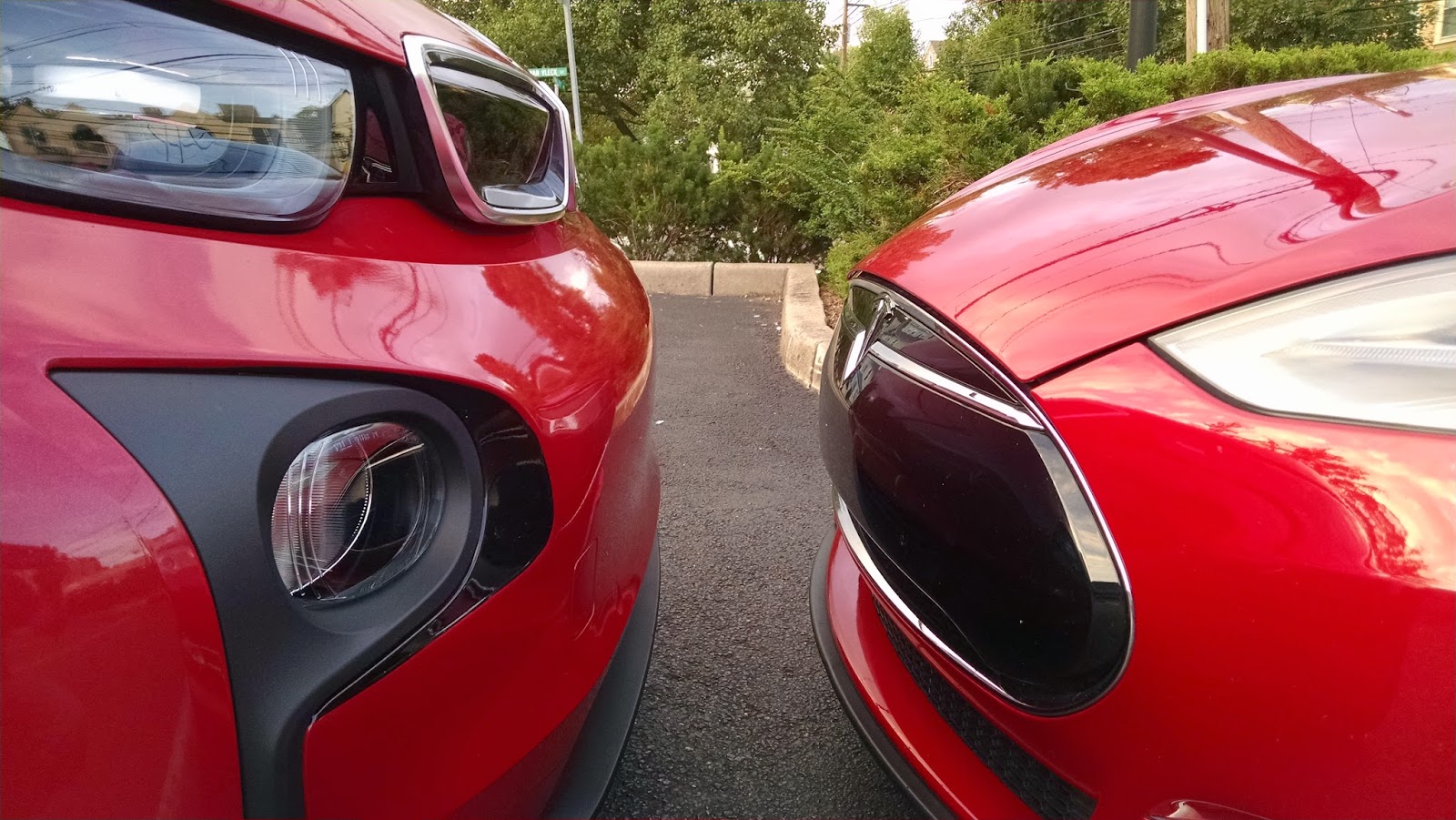
BMW & Tesla Taking Different Approaches But Will Ultimately Face Off


Horatiu Boeriu of BMWBLOG recently did a piece titled "BMW vs. Tesla - Which Company Is A Bigger Innovator?" in which he mentions that while both companies are competing in the premium automobile segment and are committed to electric mobility, they are taking different paths to achieve success.

I'm not going to try to analyze who has it right or who is a bigger innovator, but it's clear that both companies have chosen to focus on different aspects of their respective vehicles. With Tesla, it's all about the batteries. Unlike every other automobile manufacturer, BMW included, Tesla's approach isn't for their electric cars to complement their lineup of gasoline and diesel offerings since they don't have any. Instead, it is to render gasoline vehicles from their competitors obsolete. In order to do so, their cars have to be at least as good or better than most features of competing gas cars; and that includes range, performance and utility. BMW on the other hand doesn't need to necessarily worry about making everything better. They can focus on specific needs of certain customers and make a vehicle that is better than any other at a specific set of tasks, without cannibalizing sales of other vehicles in their lineup. If you accept that premise, it's not difficult to understand why we have the Model S and the BMW i3.
Tesla knew they had to knock it out of the park with their first high volume vehicle offering. They knew they had to offer a car that could stand its ground against all of the top luxury sedans while offering a range long enough to allow for road trips enabled by the Supercharger network. Even though that was an enormous task, and one that few automotive analysts really believed they would pull off, they did just that and the Model S is a smashing success. No disrespect to the sexy styling or the fabulous performance of Model S, but the heart and soul of what the car is can be attributed to the enormous battery pack it uses, filled with industry leading, high energy-density batteries. Tesla is all about the batteries. Even though the Model S uses batteries that have a higher energy density than any other EV manufacturer, they still aren't satisfied. They aren't waiting for the market to bring them better, cheaper cells for their future cars. Instead they are in the process of building what will be the first of many Gigafactories, which will be the largest lithium ion battery manufacturing plants in the world. This will drive down costs, guarantee that they have the supply that they need, and allow them to constantly upgrade to better cells without needing to wait for battery manufacturers to retool production facilities to produce them. The key to Tesla's success is having the best batteries available, and to manufacture them for less than what their competitors are paying for comparable cells. It's the only way to offer large battery, long range electric vehicles and be able to price them competitively.  It's Tesla's edge, and perhaps their only hope to compete and actually beat the large, established automakers.


BMW's not in the battery business and is unlikely to follow Tesla's path as such. As mentioned above, since they didn't need the i3 to do everything better than any other gas offering as the Model S had to, BMW could focus on a specific set of goals with their first electric vehicle. The i3's code name was the Megacity Vehicle and the goal was to develop a car that would be the perfect electric vehicle for the increasing populations within the megacities of the world. They also wanted this car to represent a departure from traditional manufacturing processes with an emphasis on sustainability.  They set out to make the most efficient production car available today and they achieved that goal. The extensive use of carbon fiber reinforced plastic and aluminum allowed BMW to shave 400 to 500 lbs off the car which played a primary role in its efficiency.

Will BMW leave Tesla in their rear view camera? That doesn't look very likely at present.
I believe the i3 is as much of a learning experience for BMW as it is their first electric vehicle. Every step of the manufacturing process was rethought and redesigned for the i3. In fact, the i3 uses 70% less water and 50% less electricity to manufacture than a comparable-sized conventional BMW would. In addition, the Leipzig manufacturing plant where the i3 is made is now completely powered by wind-generated energy. So as much as the i3 is an important vehicle to BMW today, the lessons learned bringing it to market today will pay dividends when future i cars are made. The i3 indeed paved the way for the rumored i5 and other models from the i brand. You can expect larger battery, longer range electric cars from BMW i in the not-so-distant future. I suspect by the time Tesla releases the Model III, BMW will have an electric offering which is comparable size, range and price, and that will be good news for the consumer.
My i3 had a visit by its big brother. I'm one of the few lucky people outside of some select journalists who have driven an i8 on public roads. The future is definitely looking electric!
BMW knows that by focusing on a specific set of needs (efficiency, performance, sustainability) rather than long range, the i3 isn't as well suited for road trips as the Model S. They knew that every kWh of battery that they added would sacrifice efficiency and increase the cost of the car. I still maintain that if BMW had indeed used a slightly larger battery and delivered a true 100-mile EV, it would have been much better received, but that's a pointless argument now. While it does have a shorter range, the i3 does have features that are not even available in the Model S, such as adaptive cruise control, collision avoidance with automatic braking and self parking. As you would expect from BMW, the i3 is an extremely fun car to drive, and a great addition to the current lineup of EV offerings. I think it fits in well situated directly between the Model S and the LEAF in price.
My i3 at home
BMW did realize some customers would want a longer range so they offered the range extender as an option. It's really a great option to have and while I personally like how well it works, it isn't for everybody. Many have argued that the REx ruins the purity of an EV, and while I can agree with that, I can't agree that it shouldn't be an option. If such a feature allows more people to buy a plug in car, then I think that's great. I see the range extender as a temporary fix until batteries get better, lighter and cheaper, but a necessary evil at present. Obviously BMW agrees with that and unlike Tesla, they will wait for the market to bring them improved battery tech while Tesla has decided to bring improved battery tech to the market. Different approaches, different cars and I don't think either is right or wrong. They are both working on bringing cutting edge technology to market today with the promise of even better things to come. BMW and Tesla aren't going head to head in the EV space right now, but they certainly will. Competition is good because it forces innovation. Maybe Horatiu was onto something after all.

One last point: If Nissan does deliver on the rumors that the next generation, 2016 LEAF will have a 150+ mile range, and they can deliver it for a reasonable price, then both Tesla and BMW should be concerned, very concerned...

BMW and Tesla going nose to nose in the premium electric vehicle market is inevitable.

Jumat, 11 Juli 2014

BMW i3 Repair Process Deep Dive


Occasionally I cross post content from other websites here (with permission of course) when I think the article is both interesting and exceptionally well done. Such is the case with this post written by Chuck Vossler of BMWBLOG about the repair process of the i3. I think Chuck may have taken particular interest in this story since he recently revealed to me that he has indeed ordered an i3 for his personal use. I have also been talking with him for the past year about his interest in solar electric and am happy to say he has indeed installed a solar array on his home and will soon be joining me in driving his i3 on pure sunshine, or "driving the future" as I like to say. Electric vehicles combined with solar electricity are such a fantastic combination, and adding the second one to your life is such a natural decision to come to once you have the first, as long as it's physically and financially possible to do so.

The entire article and pictures below were written by Chuck Vossler and appeared first on BMWBLOG.


The BMW i3 is truly a revolutionary new car. Revolutionary, however, is not exactly what the repair shop wants to hear when it comes to …

The BMW i3 is truly a revolutionary new car. Revolutionary, however, is not exactly what the repair shop wants to hear when it comes to fixing a totally new car. Never before has any manufacturer made such extensive use of carbon fiber in a mass produced car. One of the main benefits of the Carbon Fiber Reinforced Plastic used in the BMW i3′s Life Module passenger compartment is that it weighs about 50 percent less than traditional steel and also about 30 percent less than aluminum. The Drive Module houses a 22 kWh battery, the chassis and the 170 hp electric motor. Therefore, the new lightweight materials used in the i3 comes with totally new repair processes.


BMWBLOG had the opportunity to tour the BMW North America training facility where technicians for U.S. dealerships come to learn how to repair the very unique lightweight i3. Most consumers won’t really care about the details of how the i3 is repaired but one thing they will care about is what the BMW i3 costs to insure. The more complex and expensive the repair, the higher the insurance premium. A more complicated and challenging service and repair process directly leads to higher ownership costs which will ultimately impact sales.

Fortunately, BMW states that the cost of repairs for the BMW i3 are similar to a BMW 1 Series. This is intriguing given that once a carbon fiber piece is broken, there just is no repairing of it. The entire part/body panel must be replaced. Nonetheless BMW knew the implication of building a car of CFRP and thus designed specific cut away sections in the i3. These are defined segments that when cut will allow the technician to remove the damaged CFRP piece and then bond the new CFRP segment back in with glue.


THE DRIVE AND LIFE MODULES
BMW constructed the i3 in two segments, the Drive Module and the Life Module. The Drive Module contains the electric motor, suspension, lithium ion battery and is the backbone of the car. This module is made mostly of aluminum and its repair process is very similar to other aluminum chassis components that BMW has been producing and repairing for years.
The i3's mostly aluminum Drive Module

The Life Module is the occupant cabin and its backbone is made of Carbon Fiber Reinforced Plastic. This frame and roof are all CFRP where as attached to the sides of the i3 are composite plastic panels. These panels are designed to absorb what would normally dent a metal car and pop back into shape. Added bonus: your i3 isn’t gonna rust.

Aluminum: BMW states that standard “Cold” repair methods for the aluminum components will be used in repair. These include bonding and riveting. These methods have been used by BMW workshops since 2003.

Panels: BMW designed the panels to be replaced via standard screw/clip on plastic plated parts, so not much different really than a standard car.

Glass: The CFRP body which is surrounding and holding the glass can be damaged by a standard glass removal tool, so there is a special tool required here. Overall the mechanism of removing and replacing is similar. Standard glass removal tool uses a strong metal wire that would damage the carbon fiber, so BMW’s tool has something like a super strong fishing line.
Even replacing the glass on an i3 requires a different process and tools

Carbon Fiber Body: This is where repair techniques change significantly from standard cars. There is no pounding out damaged CFRP. In order to repair the i3, the damaged section will need to be cut out at one of the predefined points. These are located at the top of the A, B, C pillars as well as forward and aft of the floor pan.

BMW requires a specialized cutting device that looks part bone saw on the business end and part Dr Who Villain, a Dalek, to vacuum up the carbon fiber particles. Once the carbon fiber body has dis-articulated at the very specific points, the technician then places the new section on and bonds/glues it back together.
This is where my favorite part of the tour came. “This isn’t very complicated but it needs to be very precise,” says a BMW technician. He further added that the time it will take to repair i3 electric vehicles will actually be less than standard cars and thus decreased labor costs with auto repair.
BMWBLOG is happy to report that the insurance cost for the BMW i3 is similar to a 1 Series Coupe. Adding a BMW i3 to my automobile insurance policy will only raise the monthly payment by $42. Take that with a grain of salt as car insurance policies range all over the place depending on driving history, use and location.

The BMW i3 has a 22kWh battery powering a 170 hp electric motor good for an 80 mile range. It has been tested as the most efficient electric car available on the market due to its low weight with extensive use of Carbon Fiber Reinforced Plastic: 124 MPGe. The Range Extended version has a small generator in it which never directly drives the vehicle’s wheels but rather charges the battery while adding roughly 330 lbs to the vehicle curb weight.

Rabu, 21 Mei 2014

The First US i3 REx Delivery Goes To Me

My client adviser, Manny Antunes and I with my i3
This afternoon I took delivery of the first i3 REx in the US. BMW of North America was kind enough to arrange it so I'd have the very first one delivered in North America, and I would like to thank them for that. It's been a long, fantastic journey for me. Five years in BMW's e-mobility trial lease program and over 140,000 electric miles driven on my MINI-E and ActiveE has led up to me finally getting the first real production EV from BMW. This has been a long time coming and I'm very anxious to see how the i3 performs and report on it here and on other websites. I'm sure there will be things I feel need improvement, but I do expect to thoroughly enjoy the car for what it is.

BMW NA CEO Ludwig Willisch handing me the keys to the first all electric BMW in company history.             January 13th, 2011
Manny Antunes, my client adviser at JMK BMW delivered the first i3 BEV in the state of New Jersey a couple of weeks ago and now he can add the first i3 REx customer delivery in the US to his resume. Manny was also my ActiveE client adviser when I took delivery of the very first ActiveE, back in January 2011. That was a historic event because I was the very first customer in BMW history to take delivery of a 100% electric BMW, something I am very proud of. As BMW slowly transitions to more and more electric vehicles in their lineup, I'll always know I was the person who got the very first one, and that's pretty cool.

I'm sure the frequency of my posts here will increase now, and I'll also be writing about my i3 experiences for a number of EV websites including InsideEVs, Green Car Reports, Plug in Cars and of course BMWBLOG where I'll have a regular column there reporting on my experiences and all other i3 news.

I just wanted to do a quick post now to make the announcement. I'll be putting up another post soon about my initial impressions. Stay tuned!

Minggu, 12 Januari 2014

BMW i3 Samsung Galaxy Gear App Overview Video


I'm heading off to NAIAS in a few hours to cover the show for InsideEvs and one of the things I'll be doing there is meeting Horatiu Boeriu of BMWBLOG and Samsung to review and discuss their new partnership with BMW and the BMW i3 Samsung Galaxy Gear App. The above Samsung TV video shot at CES in Las Vegas last week gives an overview of the features. Hopefully I'll get more info on the partnership at the show. You can enjoy this video for now.