Tampilkan postingan dengan label sustainability. Tampilkan semua postingan

Selasa, 21 Juni 2016

BMW i Home Energy Storage System Announced at EVS29

Yesterday at EVS29 in Montreal, BMW announced an energy storage system which uses BMW i3 battery packs. The system can utilize a used i3 pack, or it will be able to be purchased with a brand new battery pack. Perhaps the best aspect of the program is the fact that if you own an i3, you can have your old battery pack built into the system when you upgrade your car with a new pack.

I've been waiting for this announcement for a while now. I can remember talking with one of BMW's top program managers from Munich three years ago. We were discussing my home solar system, and how I'd been powering my MINI-E and ActiveE electric cars with clean, renewable energy from the system for many years at that point. He then asked me the question, "What do you think will happen to your EV's battery once it has reached its end of life?" I answered that I would imagine it would probably be taken apart and recycled, with the lithium being used for new batteries. To which he said, "What if I told you when you need a new battery for your car, you'll be able to keep your old pack and put it in your house. You'll then have the ability to store your unused solar energy, and use it to charge your car at night when you get home. That will assure you're driving a true zero emission vehicle all the time." At that point I remember just smiling and he told me: "When you get your i3, I promise you you'll be able to do just that."
BMW displayed a smaller, more stylish energy storage system at CES in Las Vegas earlier this year. It appears as if each layer of this system could hold one module from the i3's battery pack.

That was three or four years ago, so obviously I'm not quoting him verbatim, but that's pretty much exactly how the conversation went. So this program has been in the works for many years now, and hopefully will be launched soon. The press release doesn't specify when the system will be available, or have any hint of pricing. The one thing I really like about this program is that BMW will allow the customer to keep their old battery pack for use in the system when they upgrade their car to a new pack. No other automaker has provided their customers a path for a 2nd life use of their own battery pack. You already paid for it, why not get another 10 years or so of use from it? Plus, it will be a great comeback when people ask sarcastically (and they do ask this), "Where do you think those toxic batteries from your electric car will end up when you need to replace them?" I can now say, "I'll hang them on the wall in my home for home energy storage," and walk away smiling.

 “With a battery storage system electrified by BMW i, our customers can take the next step towards a sustainable energy lifestyle. Coupled with the home charging and solar energy programs, the system enables BMW drivers to embrace holistic sustainability beyond e-mobility,” Rob Healey, Manager of EV Infrastructure for BMW North America.
My i3 in front of my home with an 8.775 kW solar array on the roof. I've been powering my electric cars  (MINI-E, ActiveE and now i3) with clean, renewable energy since 2010 and would love a system like this to store my excess generation for later use. Having the ability to use my old i3 battery when it's time to replace it would make it even better.
I currently have 52,000 miles on my i3. If I keep the car long term (still undecided on that), I'll probably want a new battery in two to three years when I have about 120,000 miles on the odometer. By then I'm certain BMW of North America will have started the battery upgrade program which is currently only available in Europe. In order for this 2nd life energy storage system to work, BMW would have to allow customers to upgrade their battery packs. Therefore I take this announcement as further evidence that BMW of North America will absolutely participate in BMW's battery upgrade program, even if they decided not to do so just yet.

Although it wasn't mentioned in the press release, I suspect these complete battery packs are stackable. This will allow commercial applications to stack a tower of perhaps ten of them, and store 100 to 150 kWh of energy in a 4' by 6' space. If they were using new 94Ah cells in the pack, it would store over 300 kWh in the same footprint.

This is clearly where the industry is going. Tesla was the first automaker to offer for sale a home energy storage system, and since then other OEMs have announced that they too are exploring this market.

Minggu, 27 Maret 2016

BMW i3 Key Fob Fail

Returning to your car to find the windows wide open isn't pleasant - but it's much worse if it had been raining.
Photo credit: Chuck Vossler 
Long gone are the days of a simple key to open your car's door and turn on the ignition. Keys today aren't even really keys in the traditional sense. With many cars, you only need to have the key on you and as you grab the handle of the vehicle the door will unlock. Then, you get into the vehicle and instead of inserting the key into an ignition, you simply push a button and the car will turn on. This is, in fact how the BMW i3 works, as long as you ordered the car with the optional Comfort Access feature.
BMW i3 key fob
Regardless of the other i3 features that you select, all i3 key fobs are the same. With a push of a button, they can lock or unlock the doors, or unlock the rear hatch (for MY 2015 on, the 2014 model key fob unlocked the front trunk).  Like most other key fobs, there is a panic button that sounds the car's alarm, but there is also one more function: If you long press the door unlock button, both front windows will open. This feature is used to cool down a hot cabin that may have been parked for awhile in direct sunlight. While the owner is walking up to the vehicle, they can open the windows to get some fresh air into the cabin before they hop into a sweltering hot environment. While this option certainly has a practical use, it also comes with a potential downside, that being the possibility of the owner inadvertently opening the windows by accidentally depressing the door unlock button.
No one wants to find this when they return to their car. Photo credit: Chuck Vossler
I've read about this being an occasional issue on cars of various makes. Someone with a pocket full of keys, coins or other objects can have the button depress without knowing it and have their doors unlock and windows open without their knowledge. Luckily, you need to be close enough to the vehicle for the key fob's signal to reach the vehicle, and that surely reduces the likelihood of it happening. However it does happen, and the problem can be amplified by a poorly designed key fob.

Unlocking your car door unknowingly is definitely not something you want to do, but the odds are nobody is going to notice unless there is someone actively trying to break into cars where the vehicle is parked. Having the windows wide open is much worse, as it invites passersby who may have nefarious intentions to steal items from the cabin, or even attempt to steal the car.


The edge of the button which sticks out above the key fob is protected by the key cover

This issue of unknowingly opening the windows of the vehicle because of the long press of the unlock button on the key fob seems to happen much more frequently with i3 owners than it does with other cars that have that feature on the key fob. Looking at the key fob closely, I think I know why that is. The door unlock button is located on the center and at the very top  of the fob. It also has a lip along the top edge of the button that sticks up above and beyond the black plastic trim that surrounds the fob. This lip protrudes roughly 2 millimeters beyond the leading edge of the fob, making it very easy to be depressed by accident while in a pocket or handbag that contains other items that can press against the fob.

Soaking wet Tera World interior

Over in the i3 Facebook group, and on a few other online forums, many owners have asked if anyone else has returned to their vehicle only to find the windows wide open. They are certain they didn't leave it that way and many are convinced it is the result of some malfunction on their car. Having the possibility of items being stolen from the vehicle isn't the only concern, though. Some have returned to there vehicle to find the interior soaking wet because this problem occurred during a rainstorm - or even worse, a snowstorm.


A friend of mine, journalist and i3 owner Chuck Vossler was one of the unlucky owners who had the accidental long button press and window open happen to him at a very inopportune time; during a driving rainstorm. Needless to say, he wasn't to happy about it. Here's Chuck's take on it:

"We typically park in a covered parking lot, but on a summer day last year had to park out in the open during a torrential down pour. Grabbed all of our stuff and booked out the car headed for the door at work 100 feet away trying not to get too wet. About an hour later, I had to go back to the car for something and as I was walking up to the car, my heart sank. The windows of our 2014 Solar Orange i3 with the Tera World package were all the way down on both sides. As I surveyed the soaking, was blown away by the amount of water in the car. There was so much, it was literally pooled in the seats and on our floor mats. Fortunately the eucalyptus wood wasn’t too wet.
Soaked! Photo credit; Chuck Vossler
I excused myself from work and took the i3 home. Using large bath towels, sopped up as much as I could and then was surprised to see that the WeatherTech mats caught a bunch and kept the carpets from getting too wet. Then I took a shop vac and vacuumed everything, and set all the mats out to dry and left the doors open for a few days while parked inside our garage at home. I think having leather seats instead of cloth helped it not be worse. The interior dried completely and we never smelled mold or mildew after. I write for a couple other outfits and offered to write the experience up but was told, it was user error and they weren’t interested. I buy that. But the same thing has happened to more than just us, as others have posted the same experience in the i3 Facebook Group.

We must have pressed the edge of the key somehow when running in to work during the massive rain. The i3 key we used that day did not have any covering on it. So since then, using the BMW i blue bumper’d key cover on one key and being vigilant has helped us from a second occurrence. Of note is that in owning and driving BMW’s for over 20 years, this has not ever happened to me before."

The BMW i Key Cover is available at BMW dealers or at many sites online
Luckily there is a very low cost solution which in most cases, eliminates the problem. It does however, cost the owner about fifteen dollars. I'm referring to BMW i Key Cover, accessory number 82 29 2 348 069. I've been using these covers as long as I've had my i3, which is nearly two years now and I've never had a problem. I even know some other i3 owners that have purchased the cover and put their key in it upside down, so all the buttons are covered by the hard plastic of the back of the cover. They cannot press the buttons, but if they have Comfort Access, they really don't need to. As I said above, with Comfort Access you unlock the door and rear hatch simply by touching the handle. The key fob will fit perfectly in the cover either way.
The Key Cover still works, but after a year or so it's no longer BMW i Frozen Blue
One thing to note about the Key Cover is, like most products from the BMW line, it is made with sustainability in mind. The cardboard box is made from recycled sources, and the actual cover is, "Made from sustainable, organic-based plastic & glows in the dark." That's great, and something many BMW i customers are interested in. However, the organic-based plastic also has a downside. The bright BMW i Frozen Blue color doesn't last too long. After about eight months I noticed it was turning a greenish tint, and after about a year and a half is was fully green, and no longer matches the Frozen Blue accents of my car. It grew increasing bothersome to me so I recently broke down and bought a new one. As you can see, the color variation is pretty striking. I can assure you the older greenish colored one did indeed start out looking just as the new one does now. While the plastic itself may be sustainable, the color certainly isn't!

Minggu, 05 April 2015

Q&A with BMW's Jose Guerrero at the New York Auto Show

Jose explaining the features of the concept i3 at the BMW i Born Electric Tour back in 2012

Having been in BMW's trial lease e-mobility program for five years, I've been able to get to know many of the program managers and engineers working at BMW i in North America. Jose Guerrero, Product Planning and Strategy Manager for BMW i, is one of only a few people at BMW of North America who has been a constant force in the program over the years. That's the nature of the auto industry though. People move around within the company, and often even leave to take on positions at competing OEMs.

So when I saw Jose's name on the list for available interviews at this year's New York Auto Show, I quickly reserved a half hour to sit down with him and talk about the i3 and the future of BMW i.

My i3's battery pack. It was removed from the car in less than an hour.
Future Battery Replacement

The first question was easy. There has been a lot of talk about recent comments by BMW's R&D chief Klaus Froehlich. Froehlich was recently interviewed by Automotive News Europe and asked if BMW would be offering a "more powerful powertrain" for the i3 or i8, and many took that as meaning better batteries once they become available. Froehlich said:  “I don’t think a retrofit makes sense. When better batteries are available, we could then offer models with a longer range or with the same range but at a lower price" and "replacing the batteries is very complex because they are integrated and bonded into the chassis." This didn't make sense to me because I know that any certified BMW i service center can drop the i3's battery and replace one or more of the eight battery modules and put the car back together in a couple of hours. In fact, I've personally seen it done on my car in less than a day. What would prevent BMW from upgrading these modules with higher energy-density cells once they are available in a few years? Here's what Jose had to say about that:
The underside of my i3 with the battery pack removed.

"The strategy of BMW i has always been focusing on sustainability, recycling and really maximizing the usage life of the car. I mean, first of all the car won't rust. It's made of carbon fiber reinforced plastic & aluminum so we are looking at how do we maximize the car for long usage. He didn't say it's not upgradable, but rather that at this point it doesn't seem to make sense. We really are investigating this and if it's possible, and it makes financial sense, why not? This would be in line with the BMW i philosophy. We haven't said we aren't going to do it, just that it has to make sense. A BMW i dealer can do a complete battery replacement in 3 to 5 hours so from a technical perspective it's clearly possible, we would just need to make sure it also makes financial sense. We are always getting asked, "Could you retrofit a navigation system, or Comfort Access into a car?" Yes, we could, but we'd have to rip the whole car apart. That isn't the case with better batteries once they become available, it just has to make sense. We are definitely investigating this, so if it makes sense we'll do it." Guerrero further went on to say it's conceivable Froehlich may have been misquoted or perhaps there was a translation issue because he certainly knows the batteries aren't "bonded into the chassis" as the Automotive News Europe's story indicated.

The Circuit

BMW i has recently launched a new online forum called "The Circuit". Would you like to explain why, and what exactly it is?

"We recognized these cars are different and customers will have questions that are unique to the i brand. We wanted to provide a forum where BMW i customers could communicate amongst themselves, share information and also ask BMW questions directly. There is an entire section called "Ask BMW" where customers can ask questions and get answers much faster than would have ever been possible before. It's direct access to BMW i personal that was not previously possible. We'll post information regarding technical updates, upcoming events, and all official BMW i news. It's our goal to use the forum to improve the BMW i ownership experience."

Hill Climb Assist

Late last year BMW had stated the i3 with range extender would have a software update in March which would add a new feature called "Hill Climb Assist." This was supposed to prevent sudden reduced power mode without warning while the REx was running and to make the vehicle more capable of climbing long, steep hills at highway speeds while in charge sustaining mode. Can you talk a little about this?

"This is something we are still working on. First, let me say the March 15th software update addresses part of the problem which was to provide information to help the driver avoid reduced power in these challenging driving conditions. A big gripe which the owners conveyed to us was they didn't have any warning before the vehicle reduced power. We've corrected that with a warning which comes on before the vehicle enters reduced power mode to warn the driver to alter their driving (basically that means to reduce speed) to hopefully prevent reduced power. Secondly, we've added a state of charge display so drivers can see the exact state of charge and monitor it more closely during these driving events. The the new state of charge display is also applied to the BEV i3s once they get the software update also.
An audible warning and this visual alert comes on when the state of charge drops to 3.5%, warning the driver that reduced power is possible, and giving them time to alter their driving to avoid it.  You can also see the new SOC display in the top left corner.

As for the Hill Climb Assist feature, we're still perfecting it. For the past four months we had a group of i3 REx owners beta testing Hill Climb Assist software and the feedback we got caused us to go back and redevelop it, creating an even more robust version. We are now testing a new version and once we're confident it is ready we will again give it to the beta test group for real world testing before we release it to the general i3 public. We are committed to getting this right and feedback from actual i3 owners is critical."

At this point I was shown a video of an i3 REx driving up a steep mountain climb at highway speeds in the snow. I was told this car had the new software and they were testing it in Vermont this winter on a closed road which was over 3 miles long, up steep hill at highway speeds in the snow. It should be noted that I am one of the people in the i3 REx customer beta test group which tested the previous Hill Climb Assist software. I reported back to BMW that it was insufficient, and it was my recommendation to re-engineer it before it was released to the public. I'm happy BMW agreed and look forward to testing the current version which I'm promised is more robust. I'll report on this new software once I have it on my car. It's not expected to have this new Hill Climb Assist software ready for the general public for another six months or so.
BMW i has a new North American Manager. What changes should we expect?
New Program Manager for BMW i

My last question was regarding the new Manager of Electric Vehicle for BMW of North America, Christine Fleischer. BMW i of North America hasn't had a permanent division manager since Jacob Harb left the post back in November. Prior to assuming the position at the helm of BMW i, Christine had been the BMW M & Individual Area Manager for North & South America.  I asked Jose what this means for the future of BMW i.

"Christine has now started her new role and we're all very excited. During Jacob's time here he was focused on the launch of the brand and we're now in a different phase. Now with Christine we're focusing on continuing dealer training and building sales. We're through the early adopter phase of i3 sales, and we now need to reach the early majority to continue to build sales. Dealer training is important and we'll continue to offer this specialized training so our sales force is prepared, and that's critical to maintain the sales momentum we've built. The whole team is excited to have Christine here for the next phase of BMW i."
The new North American BMW i manager, Christine Fleischer next to a 1M at the Canadian launch in 2011.
Photo courtesy of BMWBLOG


Kamis, 07 Agustus 2014

BMW & Tesla Taking Different Approaches But Will Ultimately Face Off


Horatiu Boeriu of BMWBLOG recently did a piece titled "BMW vs. Tesla - Which Company Is A Bigger Innovator?" in which he mentions that while both companies are competing in the premium automobile segment and are committed to electric mobility, they are taking different paths to achieve success.

I'm not going to try to analyze who has it right or who is a bigger innovator, but it's clear that both companies have chosen to focus on different aspects of their respective vehicles. With Tesla, it's all about the batteries. Unlike every other automobile manufacturer, BMW included, Tesla's approach isn't for their electric cars to complement their lineup of gasoline and diesel offerings since they don't have any. Instead, it is to render gasoline vehicles from their competitors obsolete. In order to do so, their cars have to be at least as good or better than most features of competing gas cars; and that includes range, performance and utility. BMW on the other hand doesn't need to necessarily worry about making everything better. They can focus on specific needs of certain customers and make a vehicle that is better than any other at a specific set of tasks, without cannibalizing sales of other vehicles in their lineup. If you accept that premise, it's not difficult to understand why we have the Model S and the BMW i3.
Tesla knew they had to knock it out of the park with their first high volume vehicle offering. They knew they had to offer a car that could stand its ground against all of the top luxury sedans while offering a range long enough to allow for road trips enabled by the Supercharger network. Even though that was an enormous task, and one that few automotive analysts really believed they would pull off, they did just that and the Model S is a smashing success. No disrespect to the sexy styling or the fabulous performance of Model S, but the heart and soul of what the car is can be attributed to the enormous battery pack it uses, filled with industry leading, high energy-density batteries. Tesla is all about the batteries. Even though the Model S uses batteries that have a higher energy density than any other EV manufacturer, they still aren't satisfied. They aren't waiting for the market to bring them better, cheaper cells for their future cars. Instead they are in the process of building what will be the first of many Gigafactories, which will be the largest lithium ion battery manufacturing plants in the world. This will drive down costs, guarantee that they have the supply that they need, and allow them to constantly upgrade to better cells without needing to wait for battery manufacturers to retool production facilities to produce them. The key to Tesla's success is having the best batteries available, and to manufacture them for less than what their competitors are paying for comparable cells. It's the only way to offer large battery, long range electric vehicles and be able to price them competitively.  It's Tesla's edge, and perhaps their only hope to compete and actually beat the large, established automakers.


BMW's not in the battery business and is unlikely to follow Tesla's path as such. As mentioned above, since they didn't need the i3 to do everything better than any other gas offering as the Model S had to, BMW could focus on a specific set of goals with their first electric vehicle. The i3's code name was the Megacity Vehicle and the goal was to develop a car that would be the perfect electric vehicle for the increasing populations within the megacities of the world. They also wanted this car to represent a departure from traditional manufacturing processes with an emphasis on sustainability.  They set out to make the most efficient production car available today and they achieved that goal. The extensive use of carbon fiber reinforced plastic and aluminum allowed BMW to shave 400 to 500 lbs off the car which played a primary role in its efficiency.

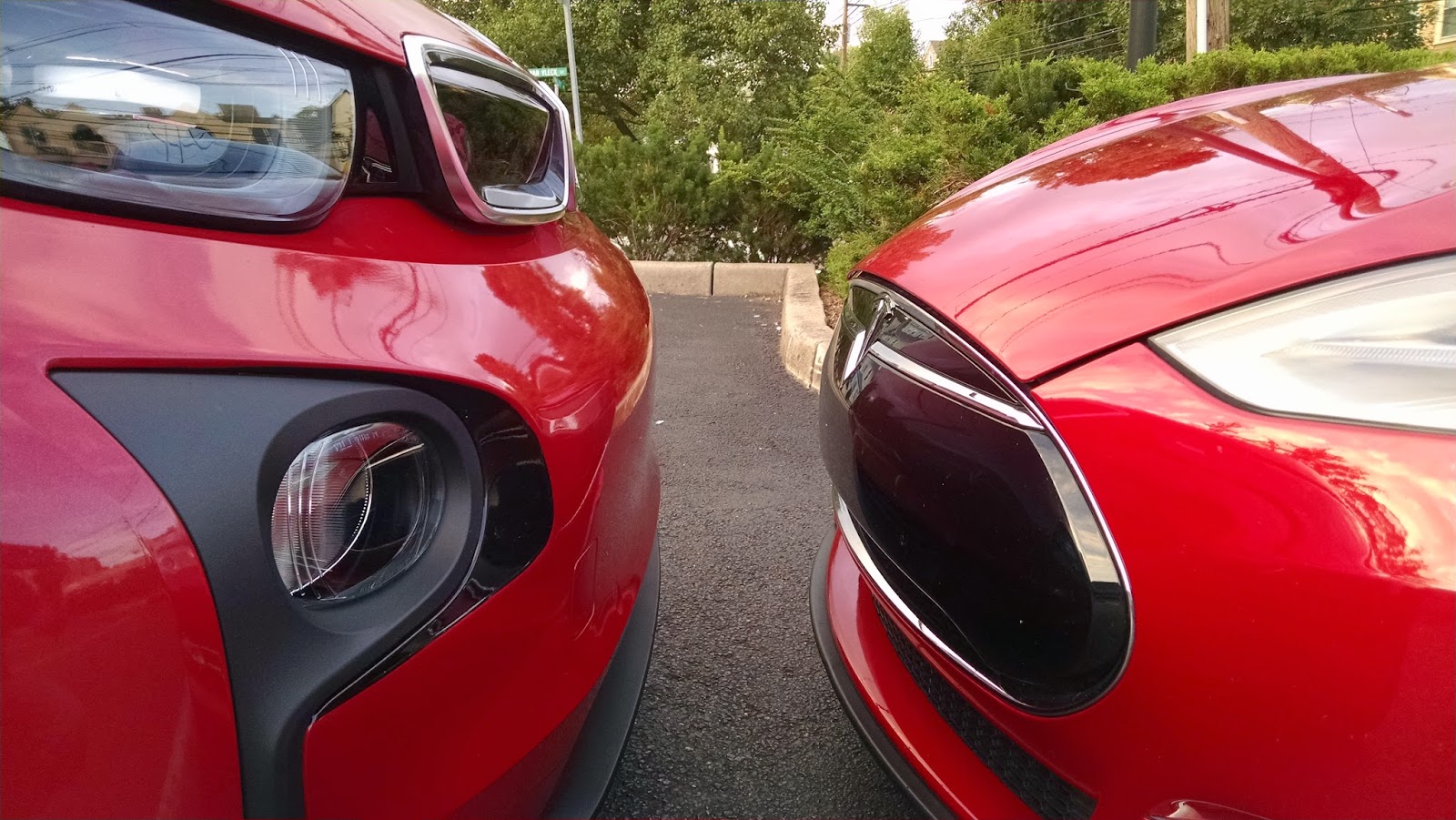
Will BMW leave Tesla in their rear view camera? That doesn't look very likely at present.
I believe the i3 is as much of a learning experience for BMW as it is their first electric vehicle. Every step of the manufacturing process was rethought and redesigned for the i3. In fact, the i3 uses 70% less water and 50% less electricity to manufacture than a comparable-sized conventional BMW would. In addition, the Leipzig manufacturing plant where the i3 is made is now completely powered by wind-generated energy. So as much as the i3 is an important vehicle to BMW today, the lessons learned bringing it to market today will pay dividends when future i cars are made. The i3 indeed paved the way for the rumored i5 and other models from the i brand. You can expect larger battery, longer range electric cars from BMW i in the not-so-distant future. I suspect by the time Tesla releases the Model III, BMW will have an electric offering which is comparable size, range and price, and that will be good news for the consumer.
My i3 had a visit by its big brother. I'm one of the few lucky people outside of some select journalists who have driven an i8 on public roads. The future is definitely looking electric!
BMW knows that by focusing on a specific set of needs (efficiency, performance, sustainability) rather than long range, the i3 isn't as well suited for road trips as the Model S. They knew that every kWh of battery that they added would sacrifice efficiency and increase the cost of the car. I still maintain that if BMW had indeed used a slightly larger battery and delivered a true 100-mile EV, it would have been much better received, but that's a pointless argument now. While it does have a shorter range, the i3 does have features that are not even available in the Model S, such as adaptive cruise control, collision avoidance with automatic braking and self parking. As you would expect from BMW, the i3 is an extremely fun car to drive, and a great addition to the current lineup of EV offerings. I think it fits in well situated directly between the Model S and the LEAF in price.
My i3 at home
BMW did realize some customers would want a longer range so they offered the range extender as an option. It's really a great option to have and while I personally like how well it works, it isn't for everybody. Many have argued that the REx ruins the purity of an EV, and while I can agree with that, I can't agree that it shouldn't be an option. If such a feature allows more people to buy a plug in car, then I think that's great. I see the range extender as a temporary fix until batteries get better, lighter and cheaper, but a necessary evil at present. Obviously BMW agrees with that and unlike Tesla, they will wait for the market to bring them improved battery tech while Tesla has decided to bring improved battery tech to the market. Different approaches, different cars and I don't think either is right or wrong. They are both working on bringing cutting edge technology to market today with the promise of even better things to come. BMW and Tesla aren't going head to head in the EV space right now, but they certainly will. Competition is good because it forces innovation. Maybe Horatiu was onto something after all.

One last point: If Nissan does deliver on the rumors that the next generation, 2016 LEAF will have a 150+ mile range, and they can deliver it for a reasonable price, then both Tesla and BMW should be concerned, very concerned...

BMW and Tesla going nose to nose in the premium electric vehicle market is inevitable.