Tampilkan postingan dengan label zero emission. Tampilkan semua postingan

Jumat, 25 September 2015

VW: Das-eption and the path to Redemption

Volkswagen CEO Martin Winterkorn resigned on Wednesday.

While this blog's primary focus is the BMW i3, I occasionally sprinkle in some featured EV products and discuss topics not necessarily i3-centric, but are instead just general electric vehicle information. In light of the recent revelations that Volkswagen has been deliberately cheating on emissions testing for many years now, I wrote the following article for Green Car Reports.

So far, no other automaker has been caught as VW has - with proof that they purposely installed a "defeat device" on the vehicles so the cars would curb their emissions only during actual emission testing. However it's fair game to speculate if other OEMs may also be exposed as cheaters now that the EPA knows what they have to look for, and how to expose it. It will certainly be interesting to watch this all unfold.

In any event, Volkswagen is going to face huge fines for intentionally violating Federal emission standards and I wanted to offer my thoughts on how I believe some of that money should be used. If we don't use at least a portion of that money to help reverse the damage done by these heavily polluting "clean diesels", I believe we will have missed a great opportunity to improve the quality of air we all breathe.


 How VW Can Atone For Diesel Deception: Electric-Car Advocate's Thoughts

The full impact of Volkswagen's diesel-emission cheating scandal has yet to be realized, but what it has apparently already admitted to doing could result in the largest civil fine ever levied by the Federal government on an automaker. And that's just the beginning.

Besides paying civil penalties, and coping with a spate of criminal actions, and class-action lawsuits, and investigations by multiple levels of government, VW also needs to deal with the 482,000 cars it sold--plus more in limbo at dealers--that clearly do not comply with emission laws.

In real-world use, these vehicles emit 10 to 35 times the allowable legal limit of certain pollutants, so they're not just slightly out of compliance. They will need to be modified to comply, or VW will have to buy them back. And if owners don't like the modified cars, they'll likely have to buy those cars back too.
After all that, VW has to figure out how to regain the trust of the public.

There are lots of aspects to this debacle, and all will undoubtedly be discussed ad nauseam over the coming weeks. But the aspect I find most interesting is how Volkswagen can best right the wrongs it has done. How does paying fines, settling lawsuits, and bringing highly-polluting vehicles into compliance really undo the damage done? It doesn't. All it does is punish Volkswagen. And I believe the public deserves more.

Make no mistake: If VW is guilty as charged, it absolutely deserves to be punished--and severely.
It turns out they aren't as clean as we were told - not nearly, actually.
But I hope the Justice Department also considers what can be done to offset the damage to air quality created by the offending so-called "clean diesels." And I hope VW, separately, does the same. We've seen penalty estimates as high as $18 billion dollars (the maximum allowed of $37,500 per vehicle for intentionally violating the Clean Air Act. I doubt the actual penalty will be anywhere close to that, but it will likely be in the billions. I think it's not unreasonable to expect the fine to be somewhere around $2.5 billion, or about $5,000 per non-compliant vehicle sold.

Why not use a portion of that civil fine to invest in a nationwide DC Fast Charge network for electric vehicles?

If just half of a $2.5 billion fine were dedicated to this purpose, we could blanket the majority of Interstate highways and major high-traffic corridors with DC fast chargers that would make switching from gasoline and diesel cars to zero-emission electric vehicles a much easier decision for many buyers. Here's why I believe that is what should be done. Helping to advance the proliferation of cleaner electric vehicles would, over time, more than reverse the emissions damage that has been done, and further improve the quality of air we breathe, instead of just punishing the offender. And shouldn't that really be the goal here?

A second thought: As well as using the fine to build out a national DC fast-charging network, how about Volkswagen getting out in front of this crisis itself and telling us how it will do its part to help clean the air it polluted?

BMW, Volkswagen and ChargePoint teamed up to create "Express Charging Corridors" on the East and West coasts. While it's a good start, much more fast charge infrastructure is needed to allow the average electric car of today to be a viable choice for long distance driving.
Rather than just declaring that it will be a leader in electric mobility, as the company has done before, show us the proof that it's serious about how it plans to expand its zero-emission vehicle offerings? VW Group could combine that with a generous investment in public charging infrastructure, on a much greater scale than last December's partnership with BMW and ChargePoint to install approximately 100 DC fast chargers.

That program in just now starting to get under way, but it's really only the beginning of what's needed. VW should commit to expanding it to 400 or 500 stations, including high-volume corridors not only on the East and West coasts but across the country--essentially following the Tesla Supercharger road map.
Tesla North American Supercharger map.
Yet another idea to consider: Give the owners of the affected vehicles the option to replace their car with a new electric Volkswagen e-Golf. Some current Volkswagen TDI diesel owners have said they now feel guilty for having driven their diesel for the past few years, with a main reason for their purchase having been both fuel economy and because it was a "clean" diesel.

Offering those owners the option to return the polluting car for a much cleaner Volkswagen could demonstrate that VW understands and is concerned with its customers' desire to drive clean cars. Many owners won't take advantage of such an offer--diesel partisans can be just as committed to their technology as electric-car advocates--but the offer would send a powerful signal about the company's intent. I believe these are the sort of things Volkswagen must consider if it wants to convince the public it is serious about making proper restitution for this egregious deception.
How about offering eGolfs to the customers that don't want their dirty diesel anymore?
There are plenty of ways to make some good come out of this shameful episode. No matter how you slice it, it will be very painful for Volkswagen AG. How well or poorly the company manages this crisis will  have a lingering effect for years to come, even decades.

It appears VW intentionally deceived both the American consumer and the U.S. government, and put public health at risk, by knowingly planning and executing a fraud. To me, and I think to many others, that's much worse than a carmaker trying to delay or prevent a vehicle recall.

But Americans are forgiving people, and sin followed by redemption is a part of our national myth. As long as we believe the offender is genuinely remorseful for what it did, and is taking steps to prove it hase learned from the offense, recovery is possible--perhaps even lauded and held up as a shining example of redemption.

Now that we've found out the real truth in German engineering, the ball has moved into VW's court to decide on what it can do to begin to offset the damage it has done to itself, its customers, and the environment.
Let's hope Volkswagen is smart enough to make the right decisions.

*Edit: BMW released a statement regarding the recent discussion of diesel engines and emission compliance. You can read it HERE.

Jumat, 19 September 2014

Born Electric Guest Blogger: Meet Harold From California


My name is Harold and I was born electric on August 19th, 2014. 

There are two parts to my story here. The first is about my path to selecting and buying the i3, and the second is about my experiences owning and driving the i3.


PART 1:  
“IF YOU’RE NOT PART OF THE SOLUTION, THEN YOU ARE PART OF THE PROBLEM.”

When it comes to global warming, I’m embarrassed to say that for far too long my wife and I were part of the problem.  We’re a two car family, and over the years we’ve driven a series of big, luxury, premium fuel guzzlers. As recently as 2007 we each had one of the full-size Range Rovers. Yikes, and yuck!

I gradually realized this was not tenable, but I found it very, very hard to give up the comfort (I’m 6’3 and don’t fit in most cars) and sportiness of a big luxury SUV. The very thought of shoehorning myself into the ugly and painfully boring Prius hybrid was enough to make me puke.

So my first tentative step in the right direction was to sign up to make annual contributions to one of those carbon-offset charities. I even got vanity license plates that said “I OFFSET.” Wow, how big and how brave of me!

Then BMW came out with a diesel version of their X5 so I dumped my Range Rover in favor of that on the theory that at least I would be burning a lot less fuel. As nice a car as the X5 was, it ended up only getting about 16mpg, and I also came to understand that the diesel wasn’t as clean as I had thought it might be.

Meanwhile, there were more hybrid cars coming on the market, but all still seemed to frumpy for me.  I’m sorry, but I live in California and I spend a ton of time in my car and I want it to look and feel great!

And then Audi launched their stylish little Q5, and I dumped the X5 in favor of this smaller, more fuel efficient vehicle. But even that only got around 20mpg. 

So about a year ago I started the search for my next car. I did my first exploration of EV’s. The RAV4 was too clearly a Toyota. The Leaf, which a neighbor of mine happily drives, drove like a turtle to me.  The Volt was claustrophobic – and a Chevy to boot. The Tesla was way cool, but I actually don’t fit very well in it and, at least in the San Francisco area, driving one has already become interpreted as a sign that you are an obnoxious snob.
So, I had resigned myself to getting the new edition of the X5 diesel, which promised to deliver significantly better – and cleaner – mileage than the original one. And then one day while I was checking out the new X5 on one of the BMW forums, I saw something about the coming of the i3. It looked weird as hell in the photo, but it sounded intriguing. I started to follow stories about it. 

I went to a car show in San Jose to see it in person. I fully expected to discover that I could not fit in it, but when I sat down in the model on display I discovered that it had more head room and leg room and better visibility than my Q5. (Of course at this point, BMW was showing it with a sunroof – more about that later….). Plus, the interior design was stunning. And the exterior, while weird, was weird in a sexy way.  So I was hooked.

When the test drives started happening in the Bay Area, I went to them at three different dealers.  Driving the car was a total blast (all the more so with the sunroof open…..) and I had to have one. I went to my dealer and said I’m willing to pay MSRP for one of the first ones you get, I just need to get two key options – the sun roof and the REX. Can you arrange that please?

And then things started to fall apart. For one, it turned out the sunroof was not going to be offered in the US.  No reason for this has ever been provided, but that alone was enough to put me off.  I’m claustrophobic, and I always felt I needed a sunroof to have the feeling of openness they give. And then some negative stories started to appear about the REX – a review in Europe said driving with the REX was like driving in limp-home mode, and then it was revealed that the REX was being modified in the US in ways that made it seem even less desirable.  And,  being new to EV’s, I was at that point too chicken to go the full BEV route.

So, I abandoned my quest for an i3. I signed off of the i3 forums and facebook group. I went back to my dealer and started haggling over prices on the X5 diesel again. But the x5 diesel remained in hot demand,  and I couldn’t get what I thought was a reasonable price. And then the i3’s actually arrived. I saw two in one day “in the wild.” I went behind my dealer’s back and went to another dealer to test drive an i3 again.  I found that even without the sunroof it still felt very open. And it was just as fun to drive as I had remembered. 

So I went back to my CA, said you’re not going to believe this, but I want the i3 after all. He laughed very heartily. We worked the numbers for a while. I ended up doing the two year version of “owner’s choice.” (Went with owner’s choice vs. lease to get the full advantage of the federal tax credit,  and went two years rather than three just because I expect the EV technology is going to advance pretty rapidly over the next couple of years and I may want to move to the next edition sooner rather than later.) And within just a few weeks I was driving my new Andesite Silver Terra i3, loaded up with everything except for the 20” wheels.  And, surprise surprise, I even got over my fear of running out of juice and went with the BEV instead of the REX.


PART 2: 
“WHO SAYS MEDICINE HAS TO TASTE BAD TO BE GOOD FOR YOU?

As I mentioned earlier, a key factor that kept me from switching sooner to a more environmentally correct car was that they all just seemed too ugly, too uncomfortable, and too boring. I wanted to do the right thing for the planet – but I wanted to still be able to enjoy driving at the same time.

Thankfully, my i3 has solved all three of those problems for me. 

While I will admit that the exterior is a bit of an acquired taste, there can be no denying that the interior is stunning. Yes, the materials are all very environmentally friendly, but more important to me – they are gorgeous. The design is very fresh,  very high tech,  and yet very simple. Among the features I like most are the floating high definition screens (one for the instrument cluster stuff, one for the navigation and multimedia stuff) and the eucalyptus dash. I also really appreciate the openness of the cabin and the great sight lines.

The interior is also quite comfortable. I was initially skeptical about the thinness of the seats.  As a veteran business road warrior, I have equated the steady thinning down of airline seats over the years with an equally steady decline in the comfort of those seats. Well, I can only hope that the designers at Boeing and Airbus get to drive an i3 soon so they can see how to make a thinner seat super supportive and comfortable.

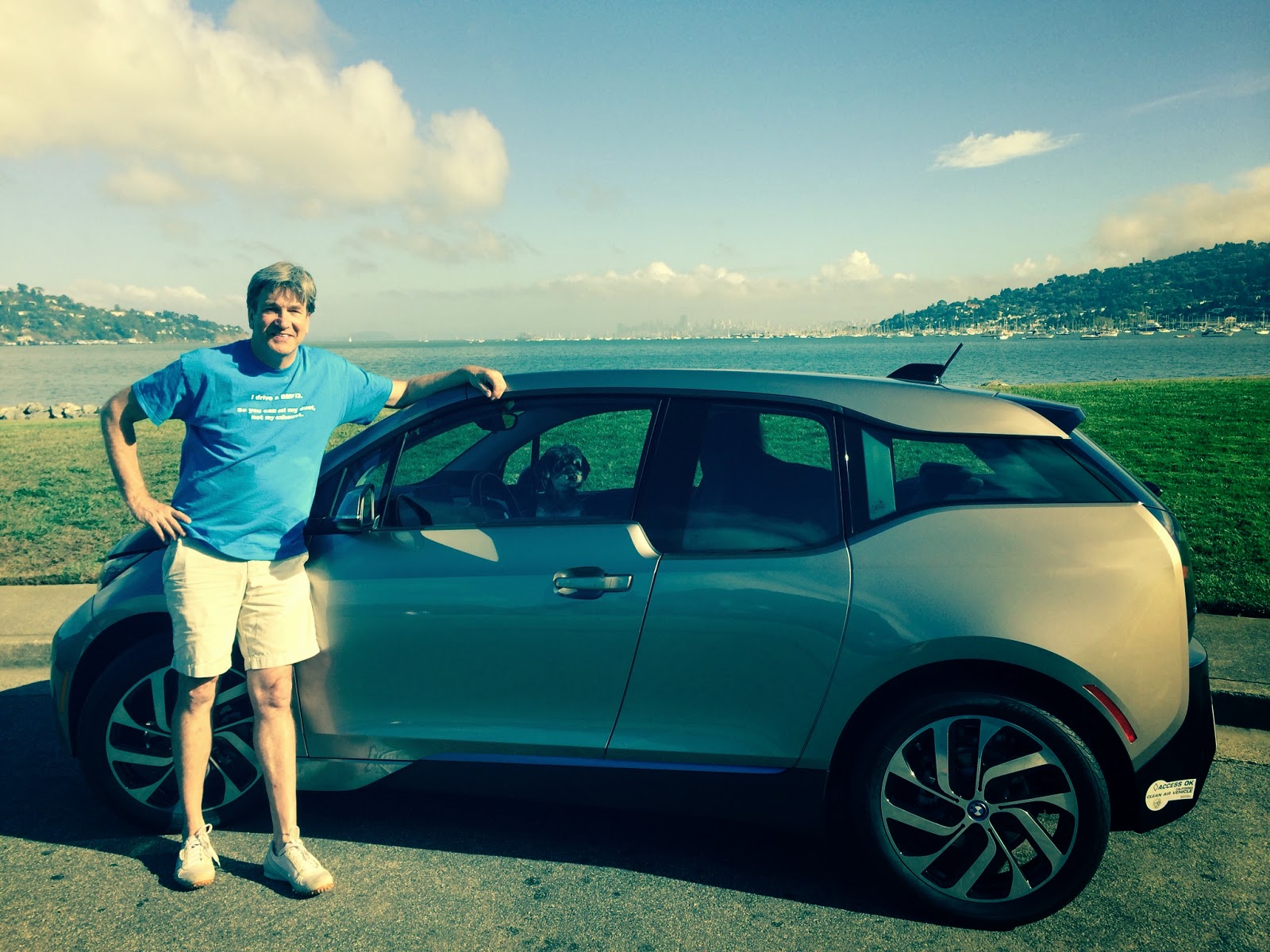
And as for the driving experience, well, I haven’t had so much fun driving a car since the very first one I owned.  First comes the peppiness. As the folks at BMW are fond of saying,  the i3 is the fastest car they make from 0 to 30 mph.  And I believe them now!  Zipping in and out of city traffic is as easy as can be – aided by how tight the turning radius is. Likewise, accelerating on to freeway ramps and passing at freeway speeds is also quick and easy. When we had a meet up of Bay area i3 drivers recently,  I had t-shirts printed up for everyone that carried this message: “I drive a BMW i3.  So you can eat my dust, not my exhaust. You’re welcome.” Trust me, the message is appropriate: this car hauls ass.
It's hard to see in the picture, but the blue T-Shirts everyone is wearing are the shirts Harold made up for the Crissy Field i3 meet. He was even gracious enough to send me a couple in the mail. Photo credit: Dino Ignacio
The steering is also very tight. I’m sure it has some degree of electronic assistance, but it doesn’t feel in the least bit mushy or vague. If anything it’s too responsive – you have to be attentive or it’s a bit too easy to oversteer.

The ride is firm, but in a good, BMW way. If you don’t want to feel the road at all, then this is not the car for you. But if you like to get some feedback from your driving, you should like this.

I really like the quietness of the car. If you keep the windows rolled up, it is super quiet; there is of course some wind noise at higher speeds, but I have not found it to be objectionable. And, at the same time, if you drive with the windows open, you can actually hear the sounds of nature!

I’m still learning all the fancy new tech tools.  Love the Harman Kardon stereo, love being able to use apps like Pandora and TuneIn. Appreciate that iDrive has gotten clearer and more manageable, though it still requires a learning curve. Love the collision avoidance system and the adaptive cruise control.  Haven’t yet tried the self-parking thing – but haven’t felt the need either, as this is the smallest car I have driven in ages and I would feel like a total wimp if I couldn’t park it by myself.  : )

As for downsides of the i3, anyone who buys this car has to accept that they are on the bleeding edge of technology and that things may go wrong. And they have for some of the early owners. But, knock on wood, after just about 1,000 miles, the worst thing that has happened to me so far is that one morning while I was driving along a nearly empty six lane freeway a warning message popped up on my screen that said something about “Danger – objects detected in roadway.” There were no objects to be seen, so I ignored the message and kept on driving and the message ultimately disappeared.

Also, if you choose as I did to go with the BEV instead of the REx, you will probably find yourself being more than a little bit paranoid about monitoring how much charge you have left. I have been running somewhere around 75 miles per full charge – a little less than what the EPA says, but then I drive with a bit of a lead foot and I leave the AC on all the time. So far I’ve only once gotten the dreaded verbal warning “you have 15 miles of range left,” and thankfully that happened when I was only about a mile from my house.

One other downside is that, to my way of thinking, the i3 is not practical as a family car. The “suicide”  doors (aka coach doors) make access to the back seat just too awkward for regular use, especially if you are trying to cope with child seats.

OK, so the i3 is good looking, it’s comfortable, and it’s fun to drive. But how does it do on my original overall reason for getting it, which is to help address the problem of global warming?

Well,  for one thing I have not been to a gas station since I got the car. And will never have to go to a gas station with it. Take that, Exxon and BP and the rest of you big oil companies! (The vanity plates I have on order for my car will read: “I86DGAS”) And, at least according to the i3 mobile app, so far I have already saved 530 pounds of CO2 from being pumped out into the air.

So,  in sum, thank you BMW for giving birth to the i3 so that I can at last do my part for solving global warming – but do it in a way that fits my own selfish needs for style, comfort, and fun!


PS- The i3 may not be right for everyone, but there are now plenty of EV’s on the market – surely one of them will be right for you!
_________________________________________________________


Thanks for participating Harold! If you drive an i3 and want to share your Born Electric story here, just send me an email and we'll set it up! tom.moloughney@gmail.com

Rabu, 28 Mei 2014

BMW i3 REx Not Tax Exempt in NJ After All

My i3 REx. Will it now cost me $3,900 more than my contract calls for?

It what can only be categorized as a major misstep, BMW of North America has announced that the i3 with range extender is not tax exempt in the state of New Jersey as what was previously reported. Back on January 27th, BMW of North America manager of Electric Vehicle sales and strategy Jacob Harb told his client advisers on a conference call that the i3 REx would be treated as a zero emission vehicle in New Jersey, and qualify for the state's Zero Emission tax exemption. That was big news at the time for New Jersey residents including myself, and was one of the final deciding factors for me to actually choose the REx version over the BEV i3.

"The sales tax exemption in NJ only applies to zero-emission vehicles--and as such, does not apply to the i3 with range-extender as it does not apply currently to any vehicle with an internal combustion engine."... "Any assumption that the i3 with range-extender would qualify was premature" 
Dave Buchko, BMW's product and technology communications


The misinformation was further reinforced at the BMW i3 dealer training event held at BMW headquarters in Woodcliff Lake in April when the client advisers were again told that the i3 REx would be sales tax exempt in New Jersey. Now that BMW has begun delivering i3s with the range extender in the State since last week, the dealers haven't been collecting sales tax on the cars since they were instructed that they didn't have to. I'm one of the people that took delivery already and didn't pay sales tax. It's unclear if BMW is going to now ask me to go back to the dealer and pay the additional $3,900.00 I'd owe for sales tax. I'm not even sure they can do that. I have a signed contract that is paid in full and I wonder where the law stands on this. I don't even know if I'd want to keep it if I have to pay the sales tax now. Don't get me wrong; I love the car, and I think the REx is a great option, but this will double the cost of the range extender. Instead of it costing me $3,850, it will cost me about $7,750! It really is a great option and so far I have loved how well it works, but it's just not worth $7,750 in my opinion. I could buy a good used second car for less than that and use it for the long trips I need to take.

Then there are the people that have an i3 REx on order here in NJ and haven't taken delivery yet, what will they do? At the last minute they find out the car is now costing them nearly $4,000 more! My good friend Chris Neff's car just arrived at the dealer yesterday and he's planning on picking it up as soon as possible. I wonder how he's going to react to it now costing him nearly $4,000 more! My client adviser Manny Antunes of JMK BMW has nine i3s with the REx options on order for customers. How many will cancel their order when they find this out? I bet at least half of them. What happens to the people like me that have signed contracts, and paid for the car already? I wonder where the law stands on this? Can we now be forced to pay more than our contracts stipulate? Personally I'm not sure what I'll do if I'm told I have to pay the $3,900 now. Will BMW NA eat the extra cost for the few people that already took delivery of their REx in NJ? Will they push it on the dealers? Perhaps this was a sign that I was really meant to get the BEV i3 after all. I've already tinted the windows and now my car is being wrapped a new color at Designer Wraps down in Millville, NJ. Will JMK BMW end up with a custom-colored, Electronaut Edition i3 REx to sell as I wait another few months for a new i3 BEV to be made and delivered? This is going to be very interesting, stay tuned!

Selasa, 06 Mei 2014

Volts For Oil: Gas Cars Burn Coal Too!


British actor and comedian Robert Llewellyn maintains a video blog called Fully Charged where he reviews electric cars and discusses all aspects of the plug-in vehicle industry. Llewellyn is an electric vehicle enthusiast and produces some really interesting and informative electric vehicle content in the series and I'm a big fan of his.

The latest topic he tackled is the "Long Tailpipe" argument which many people who do not support the switch to electric vehicles like to use in their argument against them. The Long Tailpipe argument basically states that electric vehicles are not zero emission at all, since the electricity that powers them comes from dirty sources like coal. Since EVs don't actually have tailpipe emissions, to be fair they say the real tail pipe stretches all the way to the power plant that generated its fuel, thus the long tailpipe.

There is no denying that the argument has truth to it. Much of the world's electricity is made by burning coal, and coal is dirty any way you slice it. Coal is in fact the dirtiest of all fossil fuels. When burned, it produces carbon dioxide and other emissions in flue gas. That contributes to global warming, creates acid rain, causes various respiratory illnesses and pollutes the water. However as Llewellyn shows, electric vehicles aren't the only vehicles that need electricity. Gas cars need it too, and a LOT of it in fact. Refining oil to make gasoline is an energy intensive process and the majority of energy used is - you guessed it: electricity.  

Llewellyn does a good job of explaining how much electricity is needed to refine gasoline, and that's just the refining process. He estimates that it takes 4.5kWk's of electricity to refine every gallon of gasoline. I've even seen that estimate quoted as high as 7kWh's per gallon from other sources. If you simply take the energy needed to refine the oil and put it into a battery instead of going through the whole process of refining, shipping, trucking and pumping (and the gas pumps need electric also) the stuff, you can power an EV to go 10 to 20 miles! Remember, that's just the energy used to refine the oil, nothing else. So if electric vehicle opponents want to bring up the long tailpipe argument, they then need to factor in the dirty coal emissions to every gallon of gas they burn.

However it's not as if every EV mile is powered by coal. In fact, here in the US coal fired power plants are closing all the time, and we now rely on coal for less than 40% of our electricity supply. Every year the grid gets cleaner as more renewables are introduced and outdated, polluting power plants are shuttered. This is happening as the supply chain of gasoline continues to get dirtier. How is that? That's because as we use up the current oil reserves, we are finding it harder and harder to find more. This is forcing us to use more energy to drill deeper, to go further offshore, and to even use unconventional sources like the Canadian tar sands. For example. producing one barrel of tar sands oil generates three to five times the global warming emissions that producing the same amount of conventional oil does and every day three million barrels of drinking water are used in its production. So you can see the supply chains for electricity and gasoline are moving in opposite directions. Electricity is getting cleaner, and gasoline is getting dirtier all the time.
My ActiveE and solar array. EV+PV is empowering and true zero emission driving

Plus, as the owner of an electric vehicle it is possible to make your own renewable energy to power your car. Three years ago I installed a solar array on my home and produce my own renewable energy for my EV. There is a great feeling of empowerment when you can make your own personal transportation fuel, and you know it is really zero emission driving. I've talked to many other EV owners who like me, installed a solar electric system shortly after discovering the world of electric drive. Solar powered electric vehicles are the future, we've just begun to scratch the surface of what is possible and I'm thrilled I've had the opportunity to live the future now. Anyway, back to Llewellyn's video. Take the four minutes to watch it. He does a fantastic job of explaining how gas cars are really coal powered cars too!

Rabu, 05 Maret 2014

State of Washington Approves BMW i3 REx For Sales Tax Exemption


A little over a month ago we learned that BMW i3 REx buyers in New Jersey wouldn't have to pay sales tax on the vehicle as the State was including it in the zero emission vehicle tax exemption. That will obviously help i3 REx sales immensely since it will likely save the average i3 REx buyer in New Jersey about $3,500. There was never a question of whether the BEV i3 would be tax exempt, since it is truly a zero emission vehicle, but the i3 REx isn't. The range extended Chevy Volt, for example is not tax exempt in NJ. The reasoning behind the i3 REx exemption is two fold. First, the i3 REx has about an 80 mile all electric range which is more than double the Volt's. This means for most buyers the i3 REx will likely be driven on electric much more than the average Volt owner drives their car on electricity. Secondly, the i3's range extender isn't as robust as the Volts. You could easily drive the Volt all the time without ever plugging it in. I don't know why you would buy a Volt and do that, but you could without any problem. The i3 REx on the other hand could not be driven like that, and it really needs to be charged and driven in electric mode most of the time.

So today we got news that Washington State followed New Jersey's lead and certified both the i3 BEV and i3 REx to get the State's zero emission tax exemption, saving i3 REx buyers in The Evergreen State a good chunk of change. In fact, most i3 REx buyers there will likely save as much as the REx option costs-$3,850!

I noticed that InsideEVs just put up a post about this and since I'm currently in Geneva covering the Geneva Motor show for them I figured I'd "borrow" Eric Loveday's post on this. Below is the full post he made for InsideEVs.com:

“We ARE smarter than California,” says Washington state representative Chad Magendanz.
BMW i3 With REx Qualifies For Sales Tax Exemption in Washington
Magendanz made that statement before and now he’s saying it again.
When Magendanz stated that previously, it was to make it know that he was urging the state of Washington to grant the BMW i3 REx sales tax exemption.  This idea was that Washington would jump in front of California, a state that seems reluctant to award EREVs due to the ICE on board.
Now, Magendanz is saying “We ARE smarter than California” again, but this time it’s to celebrate the fact that the i3 REx will be sales tax exempt in Washington.
Per the press release sent to InsideEVs:
  • Dept. of Revenue reverses itself, says new electric BMW with made-in-WA parts will get tax exemption after all
  • State Rep. Chad Magendanz was happy to find out that one of his prime-sponsored bills is unnecessary, now that a state agency has reversed its position on a tax exemption for electric cars.
The Issaquah Republican had been pushing legislation to clarify that electric vehicles such as the new BMW i3 qualify for a state sales tax exemption. The state Department of Revenue (DOR) told Magendanz last month that the i3 – which has carbon fiber parts made in Washington – wouldn’t qualify because of an optional gas-powered “range extender” BMW offers to consumers worried about their car running out of power. Magendanz introduced the bill to counter the department’s interpretation of the exemption law, but last week DOR informed lawmakers it had changed its mind.
“It’s a great thing when common sense prevails in government,” said Magendanz. “Unlike California, Washington is sending the message that we encourage innovative, environmentally-friendly automotive technology.”
The issue of the sales tax exemption came to Magendanz’s attention when he read that California had backed out of a deal with BMW to grant the i3 the state’s coveted “Clean Air Vehicle” white decal, which gives drivers full access to HOV lanes. California said the range extender – even though it’s optional and not permanently connected to the car – compromised the i-3’s status as a solely electric vehicle.
The i3 is expected to hit the U.S. market this spring. SGL Group in Moses Lake produced carbon fiber components for the car’s passenger compartment.
The bolded statement of “not permanently connected to the car” is clearly inaccurate when one opts for the i3 with REx.  And some of the anit-California comments are untrue too, such as the i3 not qualifying for the white sticker, which is actually does, provided its the BEV version.
Washington joins New Jersey, site of BMW’s US headquarters, in exempting the i3 REx from sales tax.